Method
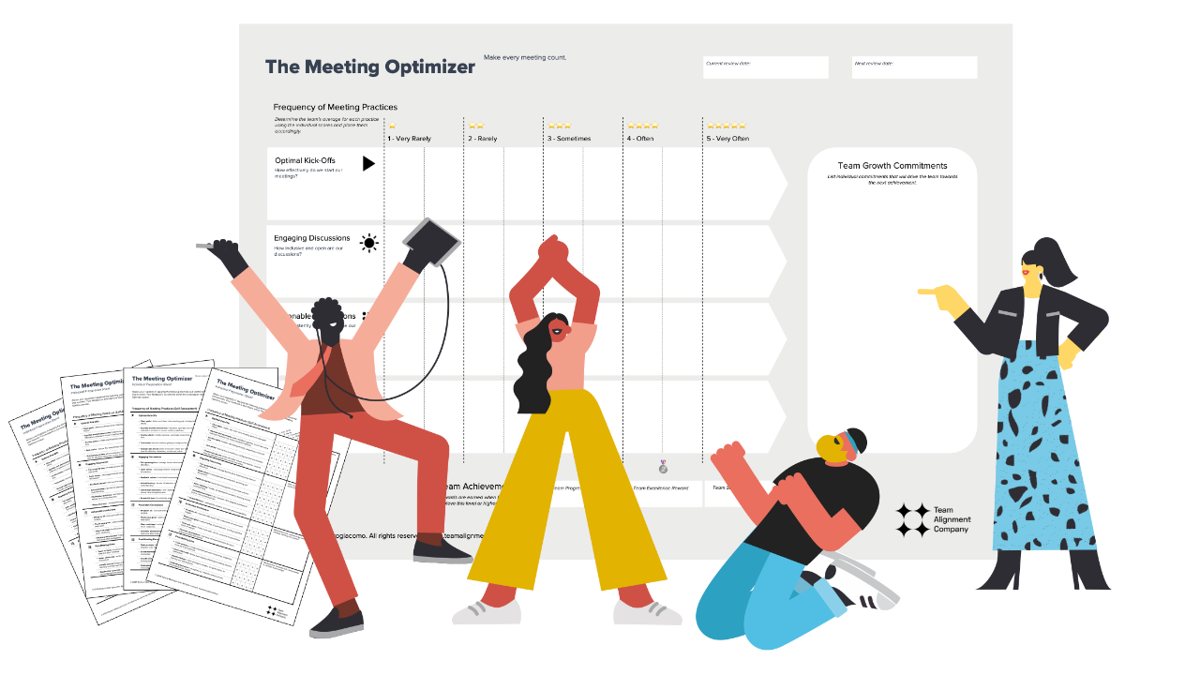
Have you ever sat in a meeting wondering whether there was a better way to spend the hour? Most of us have. The Meeting Optimizer is a one-page tool for turning that hour into something worth attending.
Why meetings still matter
The case against meetings is strong: about 67% are judged unsuccessful (The Muse), employees average 62 a month with half a waste (Atlassian) and the bill runs near $399 billion a year in the US (Doodle). Yet meetings are still where teams coordinate and decide. Managers spend roughly 80% of their time in them or answering requests (HBR). The answer is to run them well, because a face-to-face request is about 34 times more effective than the same ask by email (HBR).
How the Meeting Optimizer came about
Across more than a hundred teams over ten years, one realisation kept returning: meetings succeed on the basics. Agendas and materials shared in advance. Clarifying questions instead of assumptions. A simple thank-you. The Meeting Optimizer just makes the basics hard to skip.

It comes in two parts: a preparation sheet each person fills in alone and a poster the team uses together to agree what to improve.
How to run it
- Reflect alone. Each person rates their own meeting habits on the preparation sheet.
- Build the team view. Share the individual insights and map them on the poster.
- Commit. Set one personal and one team commitment for next time.
- Review. Revisit briefly, adapt and name what improved.
Use it for recurring team meetings, brainstorming and planning. Skip it for large presentations, external client meetings and casual or confidential conversations.

How it fits the rest of the toolkit
The Meeting Optimizer sits alongside the Team Alignment Map, the Team Contract, the Fact Finder and the Nonviolent Requests Guide, the soft-skills toolbox behind a team that runs well.
This week. Take your most repetitive recurring meeting and run the preparation sheet once before it. Download the tools, free.
Sources: The Muse; Atlassian; Doodle 2019 State of Meetings; HBR on collaborative overload and face-to-face requests. Team practices from High-Impact Tools for Teams; psychological safety from Amy Edmondson, The Fearless Organization.