Case story

In March 2020, a major hospital had to turn itself into a dedicated COVID-19 centre in days, while still protecting its other patients and its staff. We helped the Operations Department of Geneva University Hospital plan that transformation. Here is what happened and the five lessons that held.
A 1,900-bed hospital, reorganised in five days
The Team Alignment Map is a quick visual tool to align a group around shared goals, build trust, reduce risks and agree concrete action. In one intensive session, the head of operations and her deputy, the surgical-bloc manager and his deputy, the patient-flow manager and the projects team used it to:
- identify, discuss and challenge the key objectives for each unit;
- translate those objectives into joint commitments;
- identify the resources to mobilise.
Confirm the plan as a team, then act
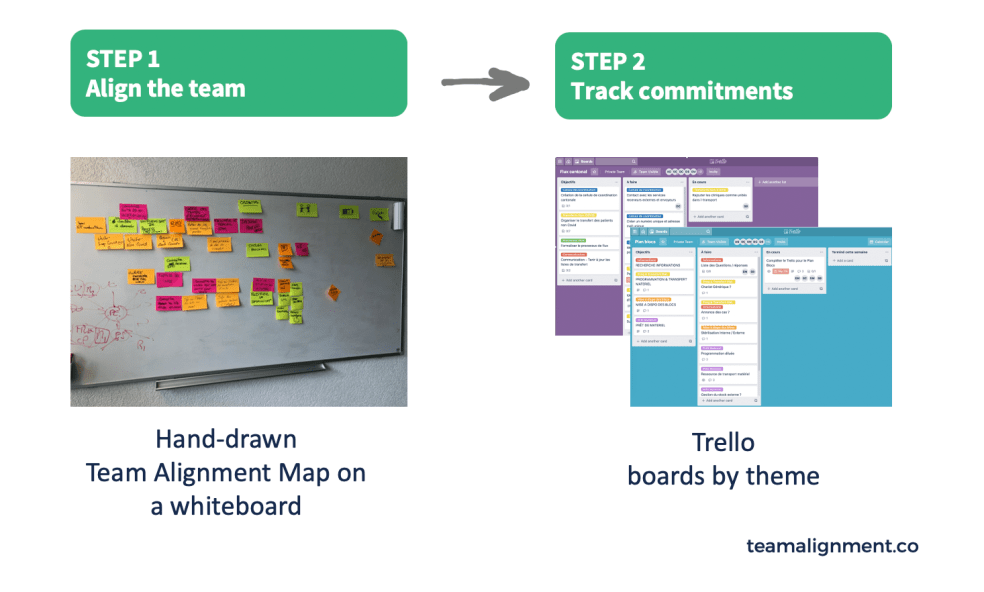
With no time to lose, we worked with whatever was at hand:
- a whiteboard and paper sticky notes to align the teams;
- an online board (Trello) to list and track the tasks.
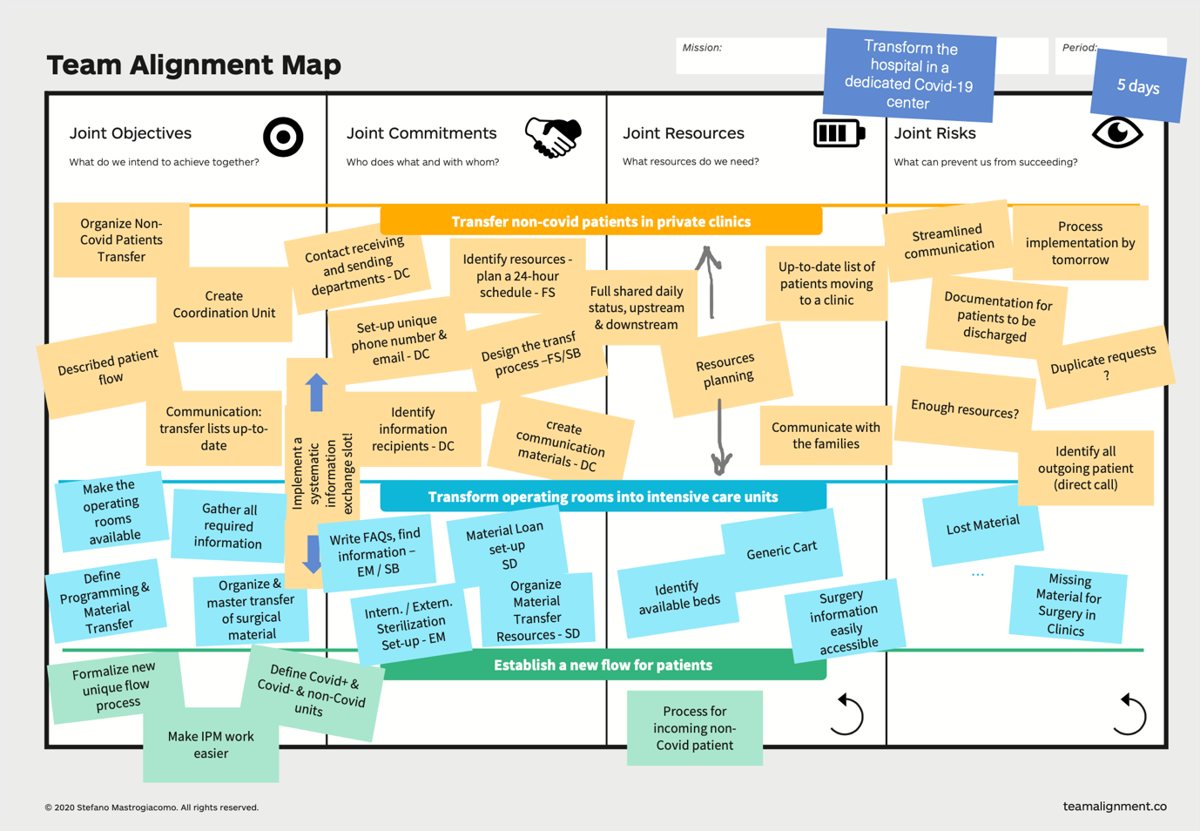
The team quickly named three challenges:
- transfer non-COVID patients to outside locations;
- convert non-essential operating theatres into intensive-care units;
- establish a new patient flow to separate COVID patients.
The resulting map looked messy. To the people in the room, facing an unfamiliar, fast-moving crisis, it was perfectly clear.
Five lessons that held
When the key stakeholders are genuinely aligned, a major institutional change can happen at lightning speed. Working alongside the hospital staff, five lessons stood out.
- One shared mission. Make it meaningful and unmistakable. Here it was simple: the patient is the priority.
- The right people in the room. The right participants and an experienced facilitator to choose the tools, frame the conversation and get straight to the content.
- Permission to go beyond standard procedure. Set aside the rules a crisis of this scale makes irrelevant and ask for a creative, collaborative mindset.
- An obsession with communication. Hold frequent, short alignment rounds to track progress and share new information.
- Constant momentum. Keep moving with the messy information at hand. Short alignment loops carry the mission forward even while some things stay uncertain, as long as everyone knows what is still missing.
Everyone's knowledge and skill mattered and so did the cooperation across every level. For the Operations Department, the map turned a complex situation into a shared picture: the challenges of each unit, the operations to run, the roles and the resources to mobilise.
Three questions for Sophie Christen Creffield
How did you and your teams feel when getting organised to fight the Covid?
Well, the staff is familiar with emergency situations but this was a novel and unknown situation for all of us, both in our professional and personal lives. However, we all quickly realized that the priority was to identify the main challenges and ensure that processes were put in place to deal with them in a very short timeframe. All the while leaving enough flexibility in these processes to deal with a rapidly changing environment that could change both actions and their timing. We were also aware that coordination with all the relevant departments and services would be key to the success of any measures put in place.
What was the contribution of the tools (TAM and Trello) to the successful organization of your teams?
Having identified our priorities, we also realised that we needed tools to be able to handle them. We needed a process and a support that ensured traceability and consistency. Having myself used the TAM in different contexts, I was convinced it would be the most effective way to rapidly bring all stakeholders together in a non-confrontational way, while affording all of us a forum for debate and an agreed way forward. I knew a TAM could transform a complex situation into a clear map, building the common ground a team needs to perform at its best. We then used Trello to support and track the goals identified during our TAM sessions, because it is easy to deploy and people did not have to spend time learning new software on top of the stress of the crisis.
What will be different at the hospital after the COVID-19 crisis?
Nothing and everything! The opportunity to share such a clear common objective was a very special situation. I believe there will always be a before and after COVID-19. We faced an unknown challenge and succeeded in taking the necessary measures to counter it, something all the staff can and should be proud of. It was also a humbling experience: we saw first-hand how close we came to a much worse outcome. Every department will be identifying what went well and what went less well. For Operations, we will focus on the tools needed to face a similar crisis and on which resources are essential in normal times versus extraordinary ones. We were all convinced the TAM is a remarkable tool for any situation that needs people aligned around clear goals.
Timeline
- March 13. Decisions to stop elective surgery, to add intensive-care beds and staff and to partner with local clinics to host non-COVID patients so surgeons could keep treating them.
- March 22. Decision to turn the hospital into a dedicated COVID-19 site; the Operations Department meets to organise the transition.
- March 23. Transfer non-COVID patients:
- identify every patient to move to the clinics;
- plan and organise the transfers;
- bring the missing surgical equipment to the clinics;
- schedule surgical procedures for the whole Canton of Geneva;
- transform the operating theatres into intensive-care rooms and reassign the qualified staff to run them.
- March 25. By Wednesday evening, all non-COVID patients had been transferred; the hospital became dedicated to the pandemic.
- March 27. Intensive-care capacity rose from 32 to 110 beds; a follow-up TAM session defined the new COVID-19 patient flow.
About
- Alain Giannattasio is an experienced team coach and facilitator who helps health and IT teams move through hard situations toward high-performance collaboration.
- Stefano Mastrogiacomo is the designer of the Team Alignment Map, the Team Contract, the Fact Finder and the rest of the team alignment toolkit.
- Pierre Sindelar is a physician and psychiatrist with deep experience in crisis management and coaching medical teams.